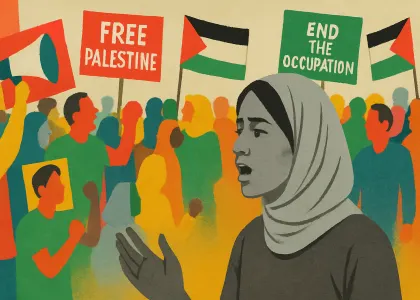
Why didn’t a Palestinian state emerge between 1948 and 1967, when Egypt controlled Gaza and Jordan controlled the West Bank? The usual answer — that Arab states “didn’t want one” — hides a deeper story. Competing Palestinian initiatives for independence were crushed by Egypt and Jordan, shaping a pattern of silencing that continues to define Palestinian politics today.
People often ask why Arab states did not establish a Palestinian state between 1948 and 1967. The common answer — that refugees were used as pawns — oversimplifies a struggle between two competing Palestinian visions: the All‑Palestine Government (APG) in Gaza and the Jericho Conference in the West Bank. One sought independence; the other handed the West Bank to Jordan. Neither outcome reflected genuine Palestinian choice.
The All‑Palestine Government: A Suppressed Bid for Sovereignty
Before 1948, many Arabs in the region identified with Bilād al‑Shām, not a distinct Palestinian nation. Identity shifted gradually, especially after the collapse of Faisal’s Greater Syria project and the creation of Jordan. By 1948, “Palestinian” had become a political identity Palestinians themselves were trying to define.
In September 1948, the All Palestine Government (APG) declared Palestinian independence over all of Mandatory Palestine, issued passports, drafted a constitution, and appointed ministers. It represented Palestinian notables and civic leaders who had advocated sovereignty for decades.
But Egypt restricted the APG from forming a military, placed Palestinian fighters under Egyptian command, and limited APG authority to Gaza. Attempts to relocate to Jerusalem or the West Bank were blocked. By the mid‑1950s, the APG barely functioned, and in 1959 Nasser dissolved it entirely, imposing full Egyptian control over Gaza. The APG became a tool in Egypt’s rivalry with Jordan, not a vehicle for Palestinian self‑determination.
The Jericho Conference: Annexation Disguised as Consent
Three months after the APG’s founding, King Abdullah convened the Jericho Conference to legitimize annexing the West Bank. Presented as a gathering of Palestinian notables, it was orchestrated by pro‑Hashemite figures. Key cities were represented by appointed loyalists, not elected delegates. Prominent Palestinian nationalists boycotted or were excluded.
Two proposals asserting Palestinian independence were rejected: one calling for recognition of the APG, and another demanding a general Palestinian congress to determine the future of the land. Instead, the conference passed resolutions requesting union with Jordan, affirming loyalty to Abdullah, demanding refugee return, and promising equal rights — symbolic clauses meant to present annexation as voluntary.
The Arab League condemned the move, but Abdullah proceeded. The West Bank was formally annexed in April 1950, recognized only by the UK and Pakistan, with the U.S. offering de facto recognition.
Why This History Matters
The APG and Jericho Conference reveal how local Palestinian political will was overridden by Arab regimes. Between 1948 and 1967, the absence of a Palestinian state was not due to lack of Palestinian initiative but to deliberate policies by Egypt and Jordan, who preferred dividing the land to empowering an independent Palestine.
After Israel’s victory in 1967, the same states that had blocked Palestinian sovereignty began championing it, reframing the Arab‑Israel conflict as the Palestinian‑Israel conflict. In the Quiet Abandonment series, I show how Egypt, Jordan, the Gulf states, the U.S., and Europe now promote a two‑state solution while resisting the emergence of a viable Palestinian state.
This new subseries, Silenced Palestinian Voices, will highlight Palestinian perspectives — historical and contemporary — that have been ignored or suppressed. While this opening article relies on historical analysis, the following pieces will bring forward Palestinian voices themselves, even when fear limits access. These articles are not meant to force a conclusion but to invite readers to approach Palestinian politics on Palestinian terms.
You can read the full in‑depth Substack version of this article here.
👉 Subscribe to my Substack newsletter to follow my new essays and access all full‑length pieces, including extended interviews, analysis, and research: Israel Diaries – The Deep Dive
Full Series
- Silencing Palestinians with reconciliation on the table
- Roots of resistance, 1967 to 1987
- Voices among the stones, 1987 to 2000
- Silenced twice – the women who led the first intifada
- Gaza and the West Bank – One people? Really?
- Survival mode in the West Bank, 2000 to 2025
- Dreams interrupted, life in suspension in Gaza
Discussion (0)
No comments yet. Be the first to share your thoughts!
Leave a Comment