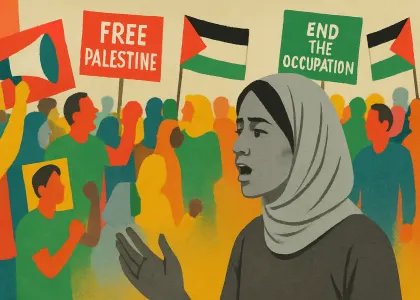
During the First Intifada, Palestinian women played a central but largely forgotten role, shaping the uprising through grassroots organizing, community care, and a form of sumud—steadfast resilience—that became a political force. While global narratives focused on stone‑throwing youth and male leadership, women built the infrastructure that sustained the movement. This article uncovers how their leadership flourished, why it was erased, and how the return of exiled male elites after Oslo pushed them back into the margins.
The First Intifada revealed a dimension of Palestinian society that history nearly erased: women’s leadership. Palestinian women described sumud as a uniquely Palestinian form of steadfastness, transforming daily survival under occupation into political resistance.
Brazilian director Julia Bacha sought to correct the silencing of women’s voices with her 2017 film Naila and the Intifada. At a 2019 screening in Haifa, the film’s blend of animation and testimony made clear how deeply women shaped the uprising. Bacha explained that the Intifada endured not because of stone‑throwing youth but because “women were at the helm,” building parallel institutions before a Palestinian government existed.
Girls discovered new freedoms as they joined the struggle. Zahira Kamal recalled, “For the first time we weren’t waiting for instructions.” Youth noticed that the IDF treated girls more gently, and women were placed at the front of confrontations. Jeans and t‑shirts replaced traditional dress as participation became a source of legitimacy rather than scrutiny.
The Infrastructure Women Built
Raja Mustafa, sixteen when the Intifada began, remembered that “all the girls my age fought… just like the men.” While 50–65% of young women joined demonstrations, their most consequential work happened behind the scenes. Because Israeli authorities did not suspect women of leadership, they moved freely during curfews, distributing communiqués hidden in bread baskets.
With many men imprisoned, deported, or killed, women created the infrastructure that kept society functioning. They organized relief committees, ran underground classes when schools were shut down, established medical clinics, and built farming cooperatives so families would not rely on Israeli produce. Naila Ayesh argued that women “made executive decisions and one even led the PLO for about 18 months.”
Yet these gains were fragile. Dr. Yara Hawari noted that Palestinian women had always been central to the struggle but faced “consistent political marginalization.” The Intifada was no exception.
Erasure After Madrid and Oslo
When the Madrid peace conference convened, several women were included, with Hanan Ashrawi as spokesperson. But Zahira Kamal saw them as “tokens,” excluded from real decision‑making. The qualities of sumud that sustained communities—patience, persistence, collective care—were dismissed once diplomacy took center stage.
Meanwhile, a secret negotiation channel in Norway bypassed the local leadership entirely. Ashrawi, who had become an international symbol of Palestinian steadfastness, was excluded from the Oslo talks. She later said the agreement lacked legitimacy because it “bypassed the collective leadership and the representatives of our people.”
Grassroots organizer Naima al‑Sheikh Ali echoed this frustration, noting that “women were left out of all preparations for the formation of the Palestinian Authority.” Ayesh added that Oslo allowed Arafat to return from Tunisia and “take the leadership away from the people and lord it over them.”
From Grassroots Power to NGO Bureaucracy
The 1980s women’s committees that mobilized thousands gave way in the 1990s to donor‑driven NGOs. Birzeit University instructor Islah Jad observed that activism was replaced by report‑writing, and accountability shifted from communities to funders.
Record‑keeping was limited, and Palestinian historiography favored male‑centered narratives. Researcher Lucy Garbett noted that while photos of women protesting were preserved, the 60–70 kindergartens enabling their activism were omitted. One committee founder told her, “They were so important, but you are the first person to ever ask me about them.”
The result was a double erasure: women were silenced during the political transition and again in the historical record.
You can read the full in‑depth Substack version of this article here.
👉 Subscribe to my Substack newsletter to follow my new essays and access all full‑length pieces, including extended interviews, analysis, and research: Israel Diaries – The Deep Dive
Full Series
- Silencing Palestinians with reconciliation on the table
- Roots of resistance, 1967 to 1987
- Voices among the stones, 1987 to 2000
- Silenced twice – the women who led the first intifada
- Gaza and the West Bank – One people? Really?
- Survival mode in the West Bank, 2000 to 2025
- Dreams interrupted, life in suspension in Gaza
Discussion (0)
No comments yet. Be the first to share your thoughts!
Leave a Comment