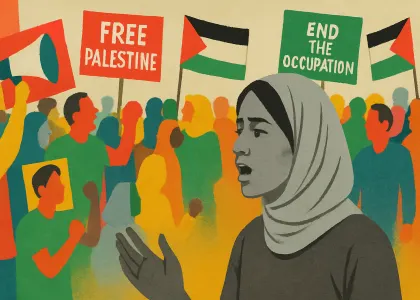
Between 1987 and 2000, Palestinian society experienced seismic political and social upheaval—from the First Intifada to the Gulf War to the collapse of the Oslo peace process. While global attention focused on protests, violence, and diplomatic breakthroughs, many Palestinian voices that challenged the dominant narrative were sidelined or erased. This article revisits those overlooked testimonies to illuminate the internal dissent, shifting loyalties, and suppressed perspectives that shaped this turbulent era.
From 1987 to 2000, Palestinian life was defined by the First Intifada, the Gulf War, and the rise and fall of Oslo. Public discourse centered on mass mobilization, resistance, and later armed struggle. Yet beneath the noise were quieter voices—dissenters, moderates, women activists, and ordinary workers—whose perspectives rarely entered the historical record.
The First Intifada began as a grassroots uprising against Israeli military rule, evolving from demonstrations and boycotts into violence once the PLO and Hamas asserted control. Israel responded with curfews, arrests, administrative detention, and restrictions on movement and speech. International support was loud, but promised financial aid often failed to arrive.
Even in this charged atmosphere, some Palestinians rejected the prevailing narrative. One woman recalled hiring a worker from across the Green Line in 1989. When her husband expressed hope for a future Palestinian state, the man replied, “The worst thing that can happen is for us to have a state.”
Another silenced figure was Mubarak Awad, a Jerusalem-born Christian psychologist who founded the Palestinian Center for the Study of Nonviolence in 1983. Influenced by Gandhi and King, he promoted boycotts, tax refusal, and tree planting instead of armed struggle. Israel deported him in 1988 for “incitement,” removing a leading advocate of nonviolence at a pivotal moment.
Women’s Voices: Brief Liberation, Swift Reversal
During the Intifada, Palestinian women stepped into public activism in unprecedented ways. Girls who had been confined to domestic life suddenly found themselves organizing, demonstrating, and taking part in what were considered “respectable political tasks.” Zahira Kamal recalled, “For the first time we weren’t waiting for instructions.” But the liberation was temporary. When the uprising waned, women were pushed back into traditional roles, a reversal that left many deeply frustrated. As Dr. Yara Hawari later wrote, women had long been central to the struggle, yet consistently marginalized.
The Gulf War: Euphoria and Its Price
The 1991 Gulf War exposed further fractures. While Israelis sealed themselves in safe rooms under threat of Iraqi missiles, some Palestinians publicly cheered Saddam Hussein. A resident of Bayt Sahur explained the sentiment: “We just wanted them to feel scared enough that they would finally make peace.” Others rejected the celebrations, warning of political disaster. A Jerusalem merchant told the Washington Post, “What a fool Yasser Arafat has been… Now the whole world will blame us for crimes for which we are not responsible.”
The consequences were devastating. Kuwait expelled roughly 300,000 Palestinians. Saudi Arabia and the UAE cut off funding. The PLO lost most of its budget within months. Palestinians who had supported Kuwait against Iraq were erased from the narrative, becoming scapegoats for a war they did not control.
Oslo: Hope, Coercion, and Disillusionment
After the Gulf War, the PLO entered the Madrid Conference weakened and isolated. By 1993, desperation pushed its leaders into the secret negotiations that produced the Oslo Accords. For some Palestinians, Oslo was a betrayal. Mohammed Massad, a former terrorist from Jenin, recalled: “I did not give anyone power of attorney to sign a deal with Arafat on my behalf.” When he criticized the new Palestinian Authority, he was arrested and tortured. “Each day of interrogations in the PA was harder than all 45 days of interrogation in Israel,” he said.
Others told similar stories. A sheikh from Tulkarem described life under the PA: “When the Israeli soldier beats me, that’s just how it is, but when a Palestinian beats me, I cannot accept that.” Human rights researcher Bassem Eid left B’Tselem in 1996 after the organization refused to document PA abuses. He founded the Palestinian Human Rights Monitoring Group and was detained by the PA for his work.
By the late 1990s, corruption, authoritarianism, and expanding settlements eroded hope. Suicide bombings and Rabin’s assassination hardened Israeli skepticism. The decade ended in quiet frustration, soon shattered by the Second Intifada.
Echoes of What Was Lost
The Palestinians who cheered Saddam lost their Arab patrons. The women who briefly tasted political freedom were pushed aside. Workers expelled from Kuwait vanished from public memory. Critics of Oslo were silenced by intimidation or co-opted by salaries. These voices, vivid in the moment, faded.
Their stories reveal paths not taken—reminders that Palestinian society contained far more complexity than the dominant narrative allowed.
You can read the full in‑depth Substack version of this article here.
👉 Subscribe to my Substack newsletter to follow my new essays and access all full‑length pieces, including extended interviews, analysis, and research: Israel Diaries – The Deep Dive
Full Series
- Silencing Palestinians with reconciliation on the table
- Roots of resistance, 1967 to 1987
- Voices among the stones, 1987 to 2000
- Silenced twice – the women who led the first intifada
- Gaza and the West Bank – One people? Really?
- Survival mode in the West Bank, 2000 to 2025
- Dreams interrupted, life in suspension in Gaza
Discussion (0)
No comments yet. Be the first to share your thoughts!
Leave a Comment