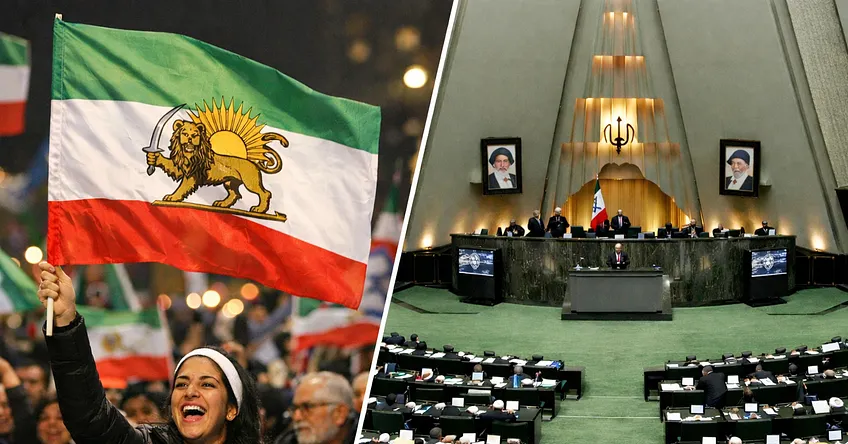
In the first week after Israel and the United States assassinated Iran’s Supreme Leader Ali Khamenei, X (formerly Twitter) erupted with celebration, predictions of regime collapse, and declarations of a new political era. But emotional volume can mislead. By tracing posts from eleven Iranian accounts — opposition, regime‑aligned, and information‑relay — this article shows what online reactions actually reveal about Iran’s political landscape, and what they cannot tell us about institutional stability.
The assassination of Ali Khamenei triggered immediate euphoria across parts of Iranian social media. Videos of celebrations, Persian flags alongside Israeli ones, and declarations of regime downfall spread rapidly. But the emotional volume reflected affect and the speed of narrative dissemination, not institutional breakdown. The regime did not visibly falter.
Eleven Iranian X accounts were examined across three time periods: before the assassination, the day of the event, and the first week of war.
Before the assassination: three communication roles already visible
Opposition accounts focused on structural critique — corruption, repression, and the security apparatus. Their tone was analytical and diagnostic rather than emotional.
Regime‑aligned accounts emphasized vigilance, legitimacy, and resistance.
A third category — information disseminators — posted videos and updates without commentary, such as clips of security forces detaining civilians.
These roles were stable even before the rupture.
Day of the assassination: emotional divergence, not structural change
Opposition voices framed the assassination as a rupture, predicting collapse and celebrating the blow to the IRGC. One account declared the regime “fundamentally destabilised.”
Regime‑aligned voices immediately invoked martyrdom, sacrifice, and unity. Saeed Jalili’s posts framed Khamenei’s death as part of a righteous struggle.
Information disseminators amplified explosions, smoke plumes, and hacked broadcasts.
The divide sharpened — but the underlying communication roles did not change.
First days of war: stabilization and narrative positioning
By March 2–4, emotional intensity cooled. Opposition accounts shifted to forward‑looking analysis: succession, legitimacy, institutional durability. Celebration remained but became embedded in political narratives.
Regime accounts doubled down on continuity, religious symbolism, and national unity. They avoided discussing succession mechanics directly.
Information accounts continued posting raw footage of strikes and damage.
What celebration volume may signal — and what it cannot
High emotional volume may indicate the presence of pre‑articulated goals and scripts among opposition groups. But it does not indicate institutional collapse. Even after the Assembly of Experts building was bombed, the regime appointed a new Supreme Leader. The regime lives on.
You can read the full in‑depth Substack version of this article here.
👉 Subscribe to my Substack newsletter to follow my new essays and access all full‑length pieces, including extended interviews, analysis, and research: Israel Diaries – The Deep Dive
Discussion (0)
No comments yet. Be the first to share your thoughts!
Leave a Comment