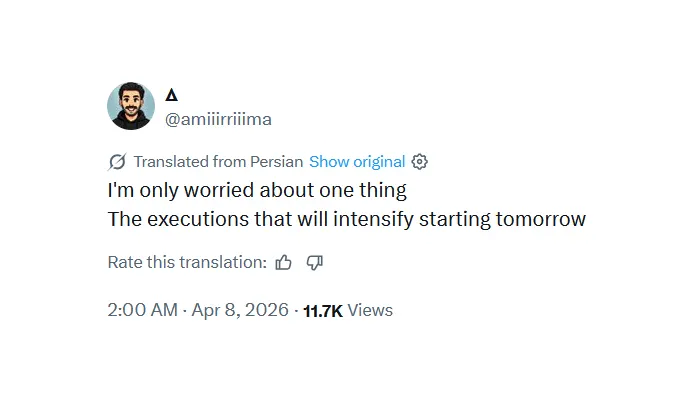
Hours before and after Donald Trump announced a ceasefire between Iran and Israel, Iranian voices on X showed some anticipating liberation and others prepared for mass executions. Messages from inside Iran described fear, blackouts, and armed regime loyalists in the streets, while diaspora accounts urged the world not to abandon protesters.
Missile alerts sounded across Israel as the ceasefire approached. The final waves had been launched before the agreement took effect, timed to enter Israeli airspace moments after it began. With uncertainty rising, my attention turned to Iranian voices online.
The night before the ceasefire exposed two opposing expectations.
Some Iranians anticipated a chance for liberation. Reza Pahlavi urged the Iranian Armed Forces to defend the nation against “foreign mercenaries” of the Islamic Republic. Others inside Iran described stockpiling supplies, losing income, and relying on Starlink as their only connection to the outside world.
Predictions circulated that Trump would claim progress while still striking regime infrastructure. Some framed Trump’s rhetoric as exposing the regime’s disregard for Iranian heritage. Messages from inside Iran pleaded for solidarity: “Whatever comes, we will endure it — just don’t leave us alone with these monsters.” Others warned that they might soon disappear from the internet and asked the diaspora to “be our voice.”
When Trump announced the ceasefire, reactions split sharply.
Some accused him of spreading misinformation, arguing that Iran had only proposed terms, not agreed to a deal. Others warned that a ceasefire would redirect regime violence inward: “The mullahs will stop shooting at Americans and instead aim their guns back at our people.”
Diaspora voices expressed frustration and despair. One wrote that waking up without electricity would be preferable to waking up “to a perfectly functioning grid” under the same rulers. Calls emerged to target regime infrastructure, not civilian systems, to “let us finish the job.”
Others argued the ceasefire was strategic — a pressure valve that weakened Iran’s leverage and bought time for further moves. Many inside Iran felt betrayed, fearing that the regime would now retaliate freely.
Voices from inside Iran described fear, crackdowns, and regime displays of power.
Some expected executions to intensify immediately. Others described armed regime loyalists parading through Tehran at dawn, chanting victory slogans as the city emptied out.
Some expressed disappointment mixed with determination: “We Iranians have endured decades of this nightmare. We’ll endure what’s coming too. But please — don’t abandon us.”
Strategic interpretations offered a different lens.
Some argued the ceasefire relieved pressure on Trump while luring the regime into overconfidence. Others claimed Iran had already lost military capacity, commanders, and infrastructure, and that the ceasefire did not end the war. Patience, they said, was essential.
You can read the full in‑depth Substack version of this article here.
👉 Subscribe to my Substack newsletter to follow my new essays and access all full‑length pieces, including extended interviews, analysis, and research: Israel Diaries – The Deep Dive
Discussion (0)
No comments yet. Be the first to share your thoughts!
Leave a Comment