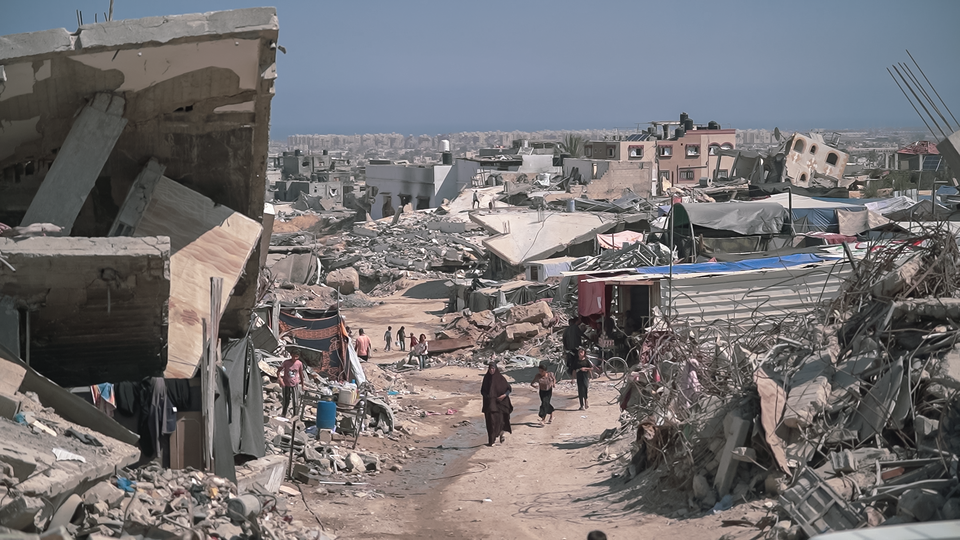
In this rare firsthand testimony from Gaza, 31‑year‑old English teacher and digital marketing professional Riwaa describes how displacement, war, and the collapse of basic services have suspended her life and her family’s future. Speaking from a tent in Al Mawassi, she recounts the loss of her home, the halted medical care for her disabled sister, and the daily fear that has replaced the full life she once lived.
When I spoke with 31‑year‑old Riwaa on Zoom, the screen froze often, her voice cutting in and out. Behind her were jerrycans, empty gas canisters, and a sack of flour—the “humble kitchen” of the tent where she now lives with her family of nine. “We are sleeping in the streets,” she said. “What separates us from the streets is just a piece of fabric.”
Before October 7th, she lived what she calls a full life. A 2017 graduate in English language and teaching methods, she worked from home for an international company, balancing digital marketing with tutoring. She went to the gym, met friends at restaurants, and spent time at the beach. “I was living my life,” she said. She had nearly completed a scholarship application to study abroad, but months without Internet made submission impossible. “This chance went in vain.”
War has punctuated her entire life. “I am 31 years old and all my life I experienced… several attacks, several wars,” she said. “Year after year, it became more and more difficult and more bloody.” October 7th brought shock and confusion: “Everything became ambiguous. We can’t predict the next step.” Life decisions—marriage, career, study—feel impossible. “Our life is in pause now. We are stuck in a period of time.”
A Sister’s Declining Health and No Way Out
The collapse of Gaza’s medical system has been devastating for her sister Alaa, who is non‑verbal and disabled. Before the war, the family had arranged to travel to Israel for spinal treatment. They paid $45,000 in coordination fees for nine family members. Two days later, Israel invaded Rafah and the crossing closed. “There is no authority there that can deal with it,” she said. “There is no proper way to travel as a human being.”
Only a few categories—injuries, disease, family reunification, student visas—allow departure. “If you are not one of these cases, you don’t have any chance of leaving.” Meanwhile, Alaa’s condition worsens daily. “We hope to get permission to leave.”
Loss, Fear, and the Question of Home
Her home in Rafah is “completely demolished.” She has lost friends and relatives. One friend was injured during an IDF operation to free hostages. “She didn’t know, of course, if this place has hostages or not,” she said.
For her, the core issue is dignity. “We have to prove to the world that we are human beings,” she said. “We have been over 20 years in an open‑air prison… We can’t travel like anyone travels in the world.”
When asked whether she would reveal the location of a hostage in exchange for safe passage, she reframed the question: “There are many Palestinians in the Israeli jails. If I asked you to let them leave, would you let them leave?” She emphasized that civilians cannot guarantee safety and should not bear responsibility for negotiations. “It’s not my duty as a civilian,” she said. “All my concentration is to be safe with my family because I’m scared.”
Her priorities are immediate: “My only mission now… is to save my sister Alaa, to save my family.” She ended with a plea: “I would like you to shed the light on my sister Alaa because she is non‑verbal and I am the one who is sharing her voice.”
You can read the full in‑depth Substack version of this article here.
👉 Subscribe to my Substack newsletter to follow my new essays and access all full‑length pieces, including extended interviews, analysis, and research: Israel Diaries – The Deep Dive
Discussion (0)
No comments yet. Be the first to share your thoughts!
Leave a Comment