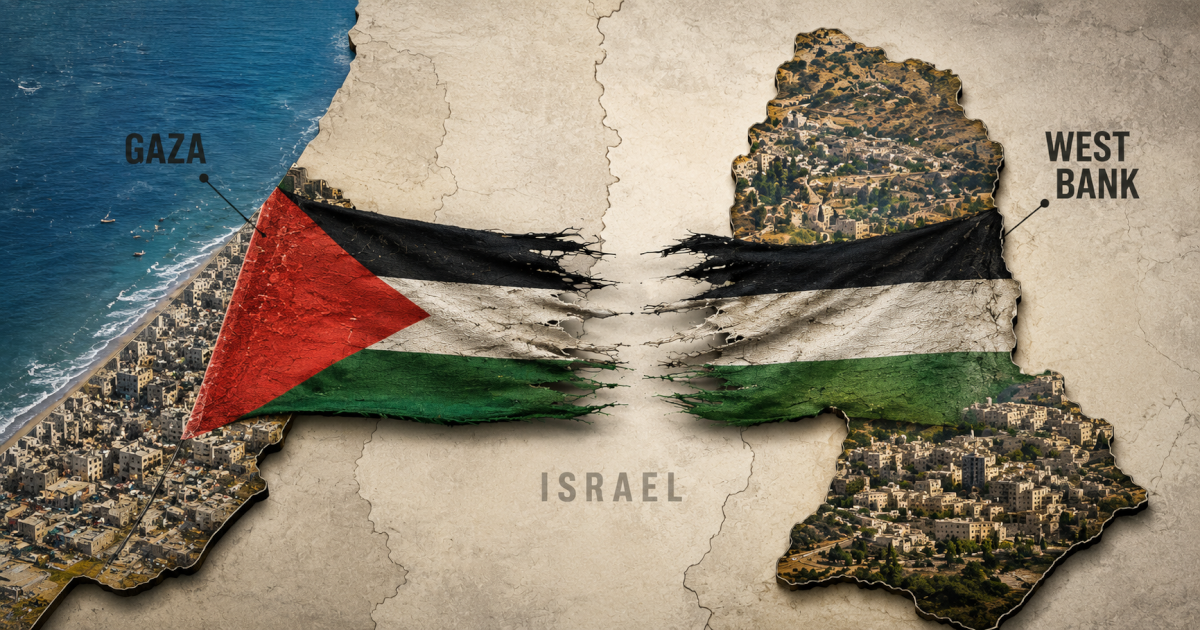
The idea of a unified Palestinian people is central to diplomacy, media narratives, and international resolutions, yet Gaza and the West Bank have never shared a single political, cultural, or historical trajectory. Since 1948, the two territories have developed distinct identities shaped by different rulers, demographics, economies, and ideologies. This article examines the deep structural divide that challenges the myth of Palestinian unity.
The world often speaks of “the Palestinians” as a single national unit, but Gaza and the West Bank have never been one cohesive people. Their separation is rooted in geography, governance, and culture. Under the British Mandate, Gaza and Judea and Samaria were administered as separate districts. After 1948, Egypt controlled Gaza while Jordan annexed the West Bank and granted its residents citizenship. Gazans who reached Jordan were denied the same rights.
Physically unconnected, they evolved as neighboring protectorates rather than parts of a shared national project.
Refugees vs. Residents: Diverging Societies
Gaza’s population exploded from 80,000 in 1947 to over 240,000 by 1950, two‑thirds of them refugees from southern Mandatory Palestine. They lived in overcrowded UNRWA camps, were denied Egyptian citizenship, and were defined by dispossession.
The West Bank, as Jordan called Judea and Samaria, also absorbed refugees, but its cities—Hebron, Nablus, Ramallah—remained rooted in long‑established families. Refugees from Jaffa, Ramle, and Haifa were more easily integrated into urban life and were granted Jordanian citizenship. This created two Palestinian identities: one shaped by permanent exile, the other by political continuity.
Economic differences deepened the divide. Before Oct 7th, Gaza’s GDP per capita was around $800–1,000, compared to $3,500–4,000 in the West Bank. Gaza’s unemployment reached 46% overall and over 65% among youth, while the West Bank’s ranged from 13–17%.
Culture, Politics, and the Illusion of Unity
Gaza’s largely Bedouin population, shaped by Egyptian influence and refugee trauma, developed a political culture grounded in resistance and religiosity. The rise of Hamas reflected this environment. The West Bank, under Jordanian rule, developed a bureaucratic, secular nationalist class that produced Fatah, the PLO, and later the Palestinian Authority.
The 1993 Oslo Accords attempted to merge these divergent societies under one Palestinian Authority. But unity was superficial. Rivalries persisted, and when Hamas won the 2006 elections, the PA rejected their authority. Hamas seized Gaza in 2007, cementing the split. Today, Hamas governs Gaza with an iron fist, while the PA controls parts of the West Bank with foreign backing and Israeli security coordination. Each arrests members of the other’s faction. Elections have been postponed for nearly two decades.
Even education diverged. While both territories officially use the PA curriculum, Hamas-run schools in Gaza supplement materials with worksheets emphasizing armed resistance and Islamic themes. Children in Gaza and the West Bank grow up with different political messages and expectations.
Former Prime Minister Naftali Bennett’s 2012 “Stabilization Plan” reflected this reality, proposing that Gaza and the West Bank be regarded differently. Bassem Eid described the same thing in 2015: “Most Palestinians in Gaza and the West Bank believe in a three-state solution: one state in Gaza, one state in the West Bank, and the State of Israel.”
You can read the full in‑depth Substack version of this article here.
👉 Subscribe to my Substack newsletter to follow my new essays and access all full‑length pieces, including extended interviews, analysis, and research: Israel Diaries – The Deep Dive
Discussion (0)
No comments yet. Be the first to share your thoughts!
Leave a Comment