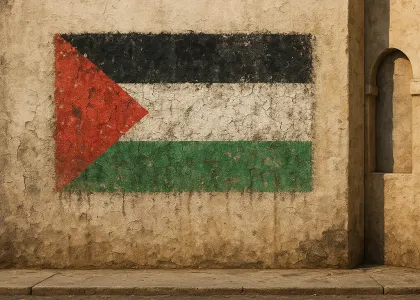
American officials continue to invoke the two‑state solution, yet U.S. policy increasingly reflects a strategy of managing rather than resolving the Israeli–Palestinian conflict. While figures like John Kerry once pursued statehood in earnest, Washington’s diplomatic machinery now sustains a framework that preserves American influence without advancing Palestinian sovereignty. The gap between rhetoric and action reveals a peace process that functions as performance.
American leaders still talk about a two‑state solution, but behind the scenes they are managing a conflict they have no intention of resolving. Some officials genuinely believe in Palestinian statehood — John Kerry’s 2013–2014 diplomacy showed this. He pursued intensive U.S.‑brokered talks and later insisted that “the only way … to have a Jewish state and two nations … living side by side in peace … is through a two‑state solution.” Yet the actions of the U.S. diplomatic system show that belief is no longer the engine of American policy. The two‑state framework survives largely as public justification for a process Washington has quietly abandoned.
American officials fall along a spectrum: true believers like Kerry; pragmatic skeptics who maintain the framework for strategic reasons; cynical actors who use the rhetoric as political cover; and those who no longer think statehood is possible or desirable. October 7th polarized these camps but did not fundamentally shift the institutional commitment to process over outcome.
The Performance of Support
This becomes clear when examining Washington’s response to recent events. When Israel’s Knesset voted in July 2024 to formally reject a Palestinian state, Washington’s reaction was routine. Secretary of State Blinken continued to affirm unwavering commitment to two states, often without acknowledging Israel’s opposition or the history of Palestinian rejections.
The Trump administration, by contrast, openly declared the two‑state solution obsolete.
The roots of this performance lie in Oslo. The Accords created a framework for managing a conflict no one knew how to end. Oslo was never a peace agreement but a transitional framework meant to last five years. That deadline passed in 1999. More than two decades later, the basic infrastructure for a Palestinian state still does not exist, yet the framework endures through bureaucratic inertia and the political cost of admitting failure.
Congressional rhetoric follows the same pattern. Pete Hegseth dismissed the two‑state solution as “lip service,” and former Rep. Jamaal Bowman called it “the thing you say so that everyone leaves you alone.” AIPAC removed explicit references to the two‑state solution from its talking points in 2023 while still claiming support.
Process Over Product
The State Department is structurally invested in maintaining the illusion of process. Oslo gives Washington privileged access to all sides. As long as talks remain theoretically possible, the U.S. retains its indispensable mediator role — a role that enabled the Abraham Accords, which unlinked Arab normalization from Palestinian statehood. By 2023, UAE–Israel trade had topped $10 billion, a tangible benefit of bypassing the Oslo roadmap while pretending not to.
Evidence of quiet abandonment is everywhere. Biden’s appointment of Hady Amr tasked him with coordinating humanitarian aid and economic reform — not mediating peace. Trump’s 2020 “Vision for Peace” proposed a demilitarized pseudo‑state under Israeli control while calling it a “two‑state solution.” Today, tying statehood to PA reform allows Washington to indefinitely postpone resolution.
A Palestinian state could also threaten core American interests. Salman Rushdie warned that “if there were a Palestinian state now, it would be run by Hamas … a satellite state of Iran.” Israel provides the U.S. with unmatched intelligence, counterterrorism cooperation, and military R&D. A Hamas‑led or Iranian‑aligned state could jeopardize these advantages.
Whether from strategic caution or institutional inertia, the U.S. now sustains a diplomatic framework not because it leads anywhere, but because it maintains influence and avoids accountability. American leaders may still say “Palestinian state,” but everything in their behavior says: not really.
You can read the full in‑depth Substack version of this article here.
👉 Subscribe to my Substack newsletter to follow my new essays and access all full‑length pieces, including extended interviews, analysis, and research: Israel Diaries – The Deep Dive
Full Series
- The Gulf States have moved on from Palestine
- Statehood? Not so fast The Gulf’s real attitude to Palestine
- Neighbours Egypt and Jordan privately oppose Palestinian statehood
- Diplomacy’s Denial: American and the peace process that is not
- Europe loudly says “Palestinian state.” Under its breath: “not really.”
Discussion (0)
No comments yet. Be the first to share your thoughts!
Leave a Comment